green woman
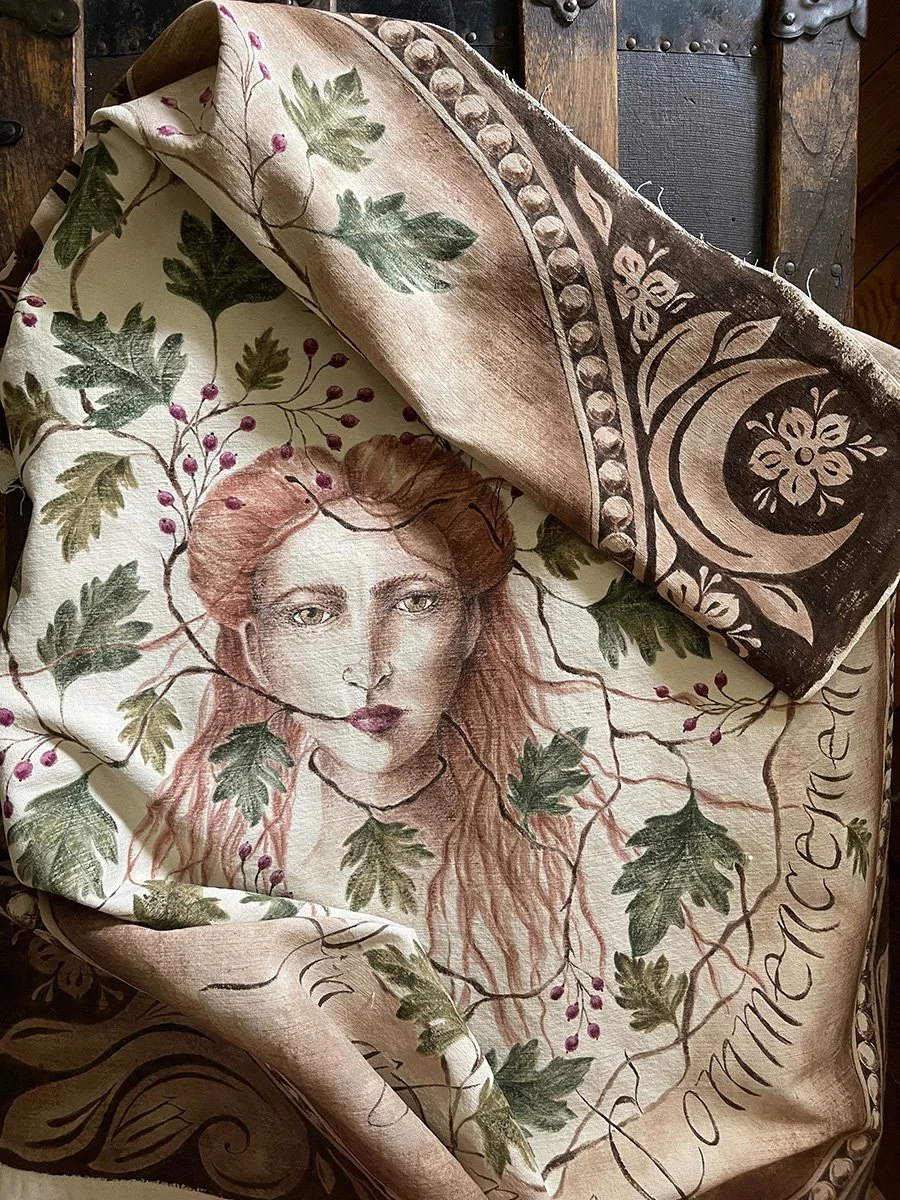
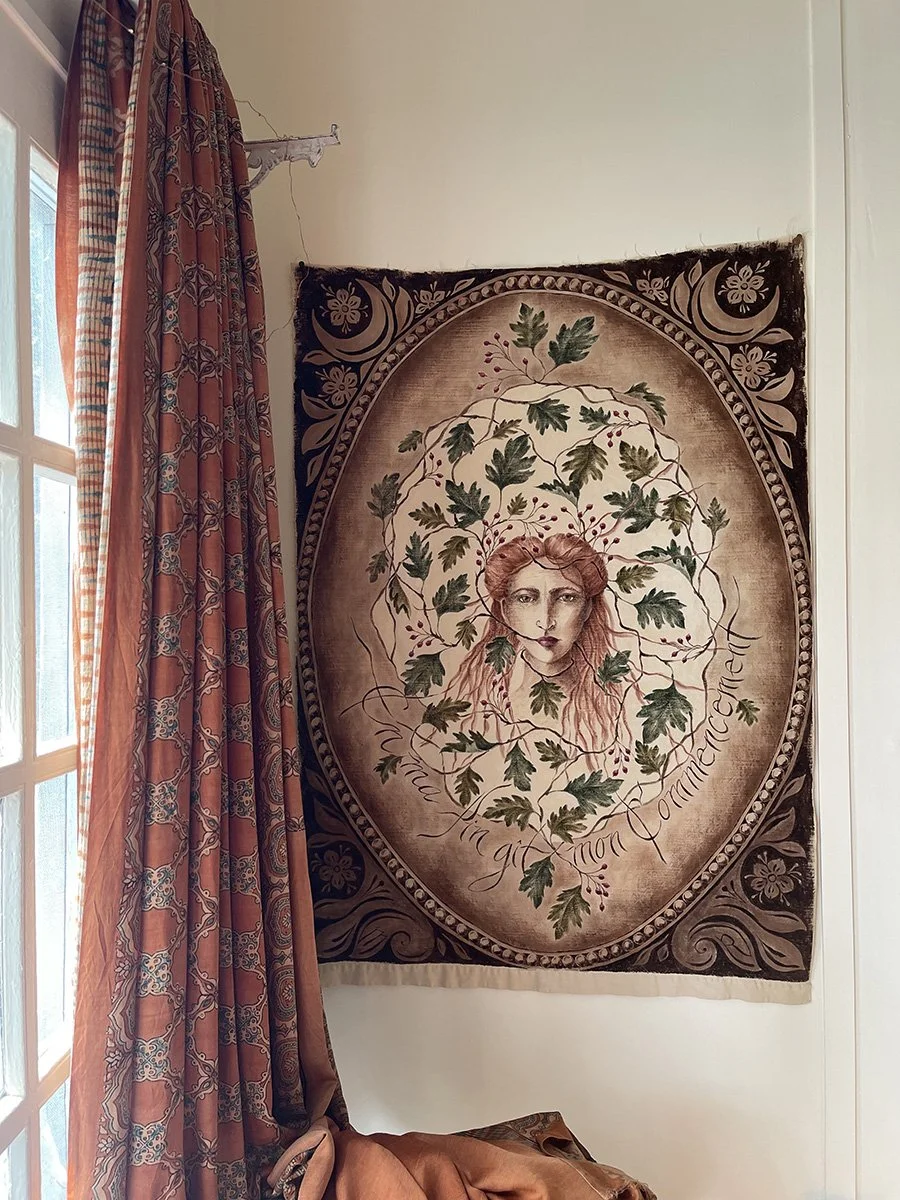
I came across the beautiful cast stone sculptures of Douglas MacDonald one day, and was so fascinated with the idea of The Green Man that it unexpectedly led me to my next tapestry. After purchasing a few of his pieces for our gardens, I was compelled to immediately start working on a new painting. Green Men are quite common in Medieval and Gothic architecture - they’re found on the facades of churches all over Europe. They symbolize rebirth and the conveyance of nature’s life force. Not surprisingly though, the female counterpart to these architectural elements are not very common. Indeed, they are actually extremely rare. It was clear what had to be done!
My circuitous way of planning paintings insisted that I manifest the spirit of Mary, Queen of Scots, as my Green Woman, which in turn led me down a rabbit hole – reading Antonia Frasers biography of Queen Mary, and then digging up imagery of every statue, painting, drawing, and sculpture of Mary’s likeness that I could find. That, in turn, led me into an even deeper exploration of the symbolism surrounding her.
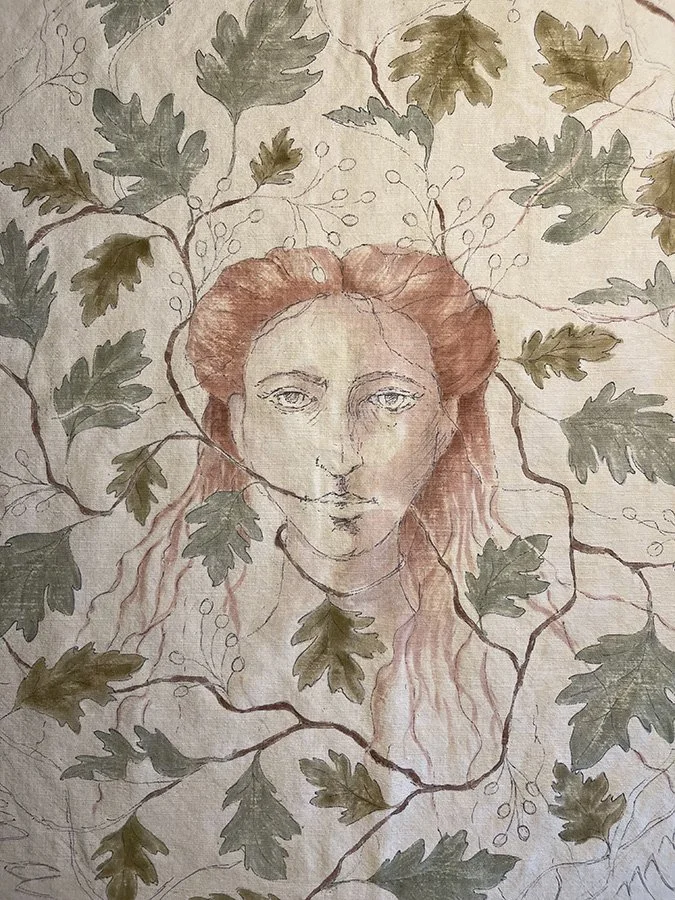
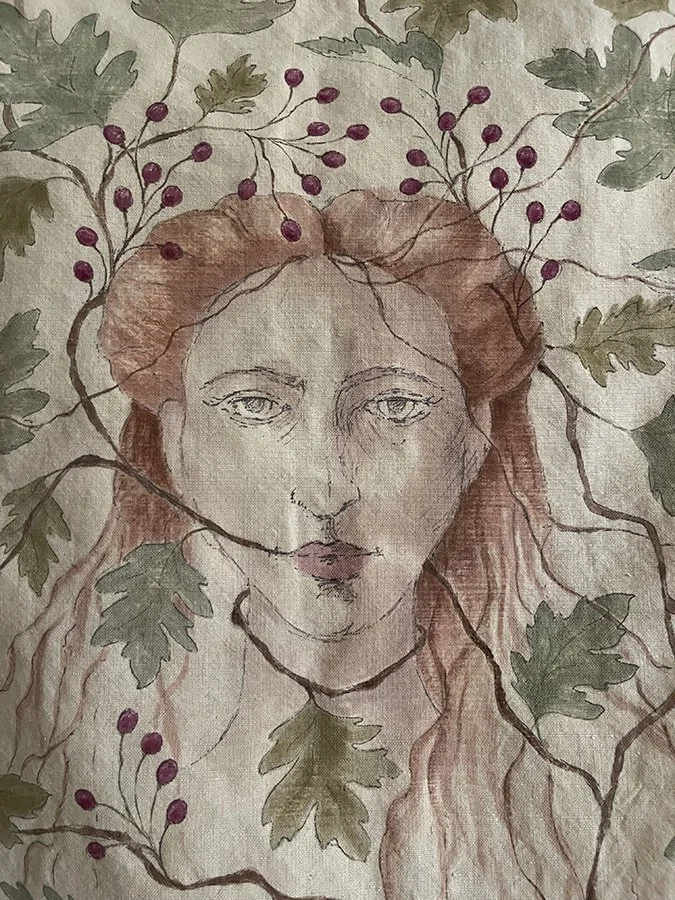
Mary was said to have planted many trees during her short life, one of which was a Hawthorn tree in the courtyard of the University of St Andrews. It still stands today and produces fruit and flowers each year. In folklore, solitary hawthorns ("lone bushes") are viewed as gateways to the Otherworld where nature spirits and the "Wee Folk" live and guard the land. The bright blossoms symbolize the return of summer, abundance, and life. Some old European traditions also associate its pungent flower scent with decay and caution, treating it as a strict threshold between life and death.
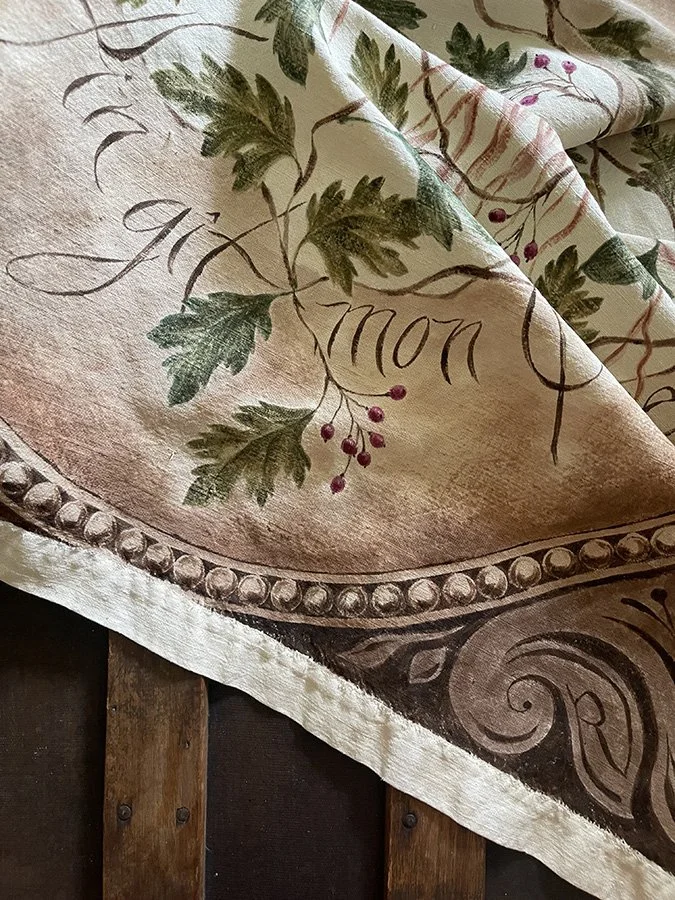
I loved the odd interconnectivity between all these thoughts swirling around in my mind. They were the makings of the story that would become my next painting. But first my Queen would deliver a message… words trumpeted through the growth of new foliage and gnarled branches.
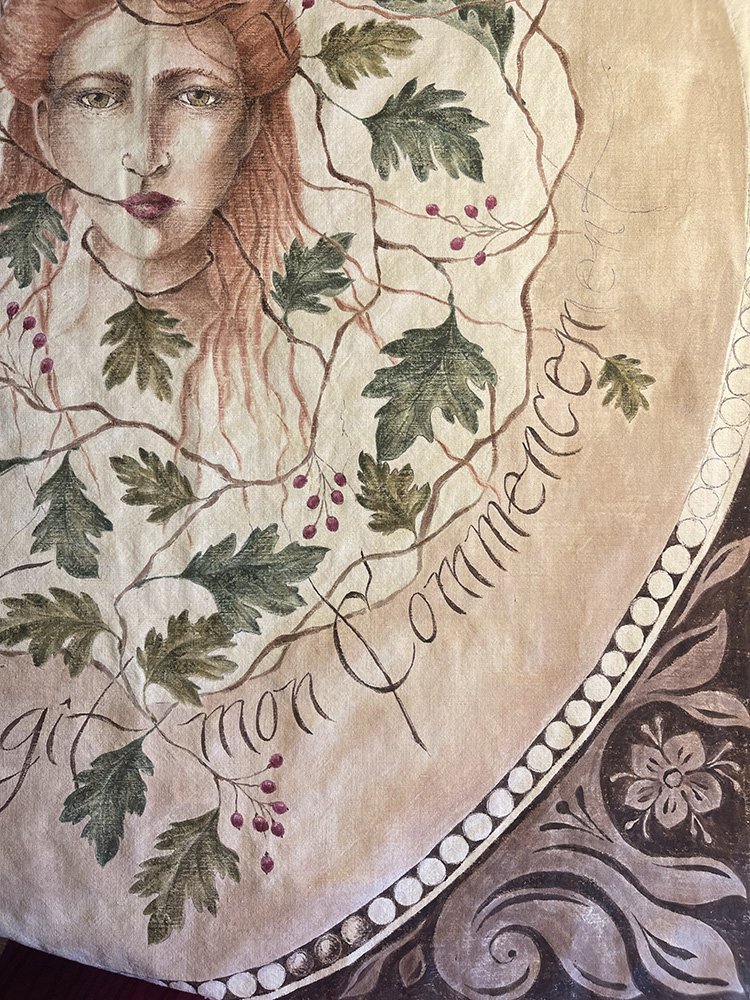
Mary was just six days old when she inherited the throne of Scotland. She spent her early years in France (married and widowed by the age of 18) and then ruled a divided Scotland for only a few years before being imprisoned by her cousin, Queen Elizabeth, who regarded her very existence as a threat. She spent nineteen years confined to various castles and manors throughout England before being beheaded. She often passed her time during these years with the art of embroidery. The beautiful, emblematic scenes she created were both a diversion, as well as political messages for her followers. One of the pieces she embroidered in her final years was the quote “En ma fin git mon commencement.” which translates to “In my end lies my beginning.” Even as she waited for execution, she knew that her passing would not silence the resonance of her voice. Remembrance and strength after death. A renewal of spirit across centuries and miles. She was the embodiment of a Green Woman, if there ever was one.
One of the most beautiful artifacts I came across in my searches of all-things-Mary was a ring that’s now in the Swiss National Museum. It looks like a gold signet ring of the 16th century, beautiful, but quite common for the era. It appears to be engraved with a family crest but when you look closely at it, it’s actually the Scottish coat of arms and engraved in the inside are the words "MARIA RÑA NOSTRA" (Mary, our Queen). The person wearing this would have had to hide their devotion to Queen Mary. It struck me as such a tender and defiant act, and it made me wonder if Mary knew how much she was loved - if she somehow knows still. What she would think of Sir John George Tollemache Sinclair, a member of parliament who had such a deep fascination with Mary, that when he commissioned the development of a building on Fleet Street in London in 1905, he had architect R. M. Roe create a life-size sculpted stone statue of her to be placed in a prominent Gothic niche just above street level. Or, on a much smaller scale, what she would think of me painting her as a Green Woman. For here I am, in the year 2026, thinking of her every time I walk past the Hawthorn tree on my street, separated by thousands of miles and hundreds of years, from the one she planted in Scotland in 1563.
A few other things that inspired me while painting this piece.
actresses Saoirse Ronan and Julia Bache-Wiig
John William Waterhouse’s Ophelia
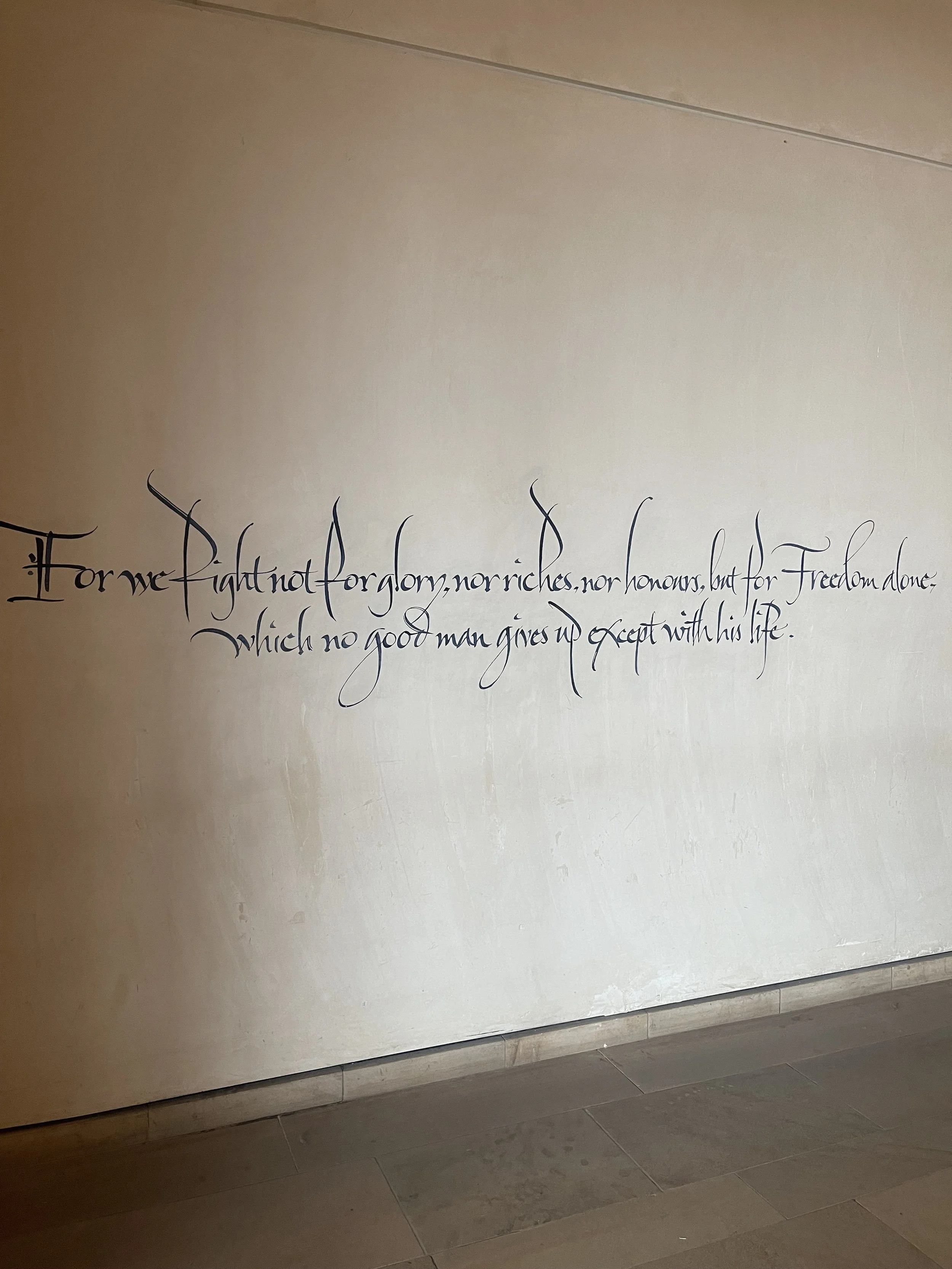
the full-wall lettering of The Declaration of Arbroath inside the entrance of National Museum of Scotland in Edinburgh.